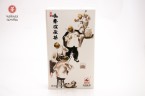
Hei Cha "Roaring Opera", "AA" 2017, 900 g.


As is known, there is some confusion in the Chinese and European classifications of red/black tea. However, in China, hei cha (Chinese: “black tea”) is known and occupies a special place in the classification. It is strikingly different from hong cha (Chinese: “red tea”, called “black” in the West), both in production technology and in taste. The main distinguishing feature of hei cha is the “wo dui” stage, or wet stacking, during which the moistened tea raw materials, stacked in a large pile, undergo complete fermentation. Due to the special technological process, hei cha acquires a unique chemical composition (fermentation leads to a high degree of splitting of complex leaf compounds into shorter ones) and flavor profile. An important component influencing the taste and effect of hei cha is also the reproduction of the fungal culture “Jin Hua”, or “Golden Flowers”, in the tea raw materials during the post-fermentation process. It is generally accepted that the interaction of tea raw materials and fungal waste products has a pronounced positive effect on the body of the person drinking hei cha.
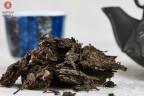
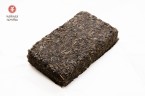
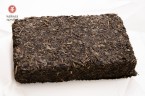
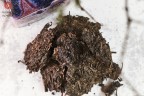
The tea raw material of this variety is pressed into a large brick and looks a little sloppy, unusual in relation to other types of Chinese tea: here and there, brown-yellow tea branches are visible between the dark uneven leaves. Tiny golden dots - "Golden Flowers" - are clearly visible on the surface of the chip. The smell of campfire smoke, forest substrate, fallen autumn leaves, wood mushrooms. When warmed up, smokiness and smokedness come to the fore.
You can brew it both hotter, at 90 degrees, and a little colder, at 85-75. In the first case, the tea turns out more smoky, smoked and forest, in the other - sweet and herbaceous. It is good to use a clay teapot, for example, Yixing, developed for shu pu-erh. A chip of 7-8 grams from a brick per 100 ml of volume.
The color of the infusion is golden-orange, with rowan redness. The smell has notes of smokiness, sweetness, a collection of medicinal herbs, it feels cozy, pleasant, like an old wooden house in the village at grandma's, a little damp, but drying from the heat of a just-lit stove. The taste is much softer than you expect from raw materials of such a rough type: sweet, a little "puer", with woody spice and a taste of dried apricots or prunes. It is not bitter or astringent at all. It is a bit reminiscent of dried fruit compote. In the middle of the infusions, a note of resinous pine needles, the aroma of rotten leaves and mushrooms breaks through. The aftertaste is iron, unstable, but distinct.
The tea is very calming, envelops you in peace and relaxation. It relieves stress and removes anxious thoughts from your head. It is good for the end of a difficult week, an evening after a hard day at work. The variety will be interesting for lovers of shu puer, for some similarity of the taste profile, and lovers of oolongs, for the calming effect. It is also worth trying if you want something really unusual.
